Entering Hydrogen Directly
The EPI Suite programs allow hydrogen to be entered when it is explicitly connected to either an aromatic or aliphatic nitrogen atom. However, the hydrogen is used by the programs only if the valence of the nitrogen atom is greater than +3. Nitrogens with a valence of +3 ignore the direct hydrogen entries. For example, a SMILE entry of: CCN(H)(H) will be converted to: CCN (ethylamine) because the nitrogen is already understood to have two hydrogens implicitly connected to it. However, for various structures, the hydrogens must be entered to specify the correct structure. For example, the SMILES notation for ethyl ammonium bromide must include the hydrogens {e.g. CCN(H)(H)(H)Br }... if CCNBr is entered instead, the nitrogen will be evaluated as a +3 valence instead of a +5 valence. In cases where the nitrogen is greater than a +3 valence, the hydrogens must be explicitly entered in the SMILES.
There are two common instances where explicit entry of hydrogens is necessary: (1) various organic hydrochlorides and (2) various zwitterionic compounds. The evaluation of hydrochlorides and zwitterionic compounds applies primarily to octanol-water partition coefficients.
Here are some example SMILES that use explicit hydrogens:
(1) acridine hydrochloride: c1ccc2cc3ccccc3n(H)(CL)c2c1
(2) benzenepentanamine hydrochloride: c1ccccc1CCCCCN(H)(H)(H)CL
(3) ammonium bromide: N(Br)(H)(H)(H)H
Hydrochlorides
SMILES notations for hydrochlorides usually envolve a “disconnected” structure. For example, the SMILES notation for benzenepentanamine hydrochloride may be specified as: c1ccccc1CCCCCN.HCL ; however, as noted above, the EPI Suite programs can not evaluate a disconnected SMILES. To specify this compound, the SMILES should be entered with explicit hydrogens and no “.” symbol as: c1ccccc1CCCCCN(H)(H)(H)CL . The KOWWIN program (octanol-water partition coefficient) can evaluate the hydrochloride as the ionized form of the compound. The non-ionized form of benzenepentanamine hydrochloride can be evaluated by removing the hydrochloride altogether (and simply entering c1ccccc1CCCCCN). For EPI Suite programs, hydrochlorides (and any similar disconnected structures) must use explicit hydrogens for correct evaluation.
Zwitterions
With the exception of amino acids, zwitterionic forms of compounds must use SMILES notations containing explicit hydrogens. For example, consider the non-zwitterionic and zwitterionic forms of 1-leucyl-L-proline as shown here.
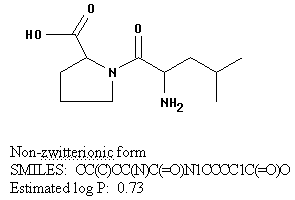
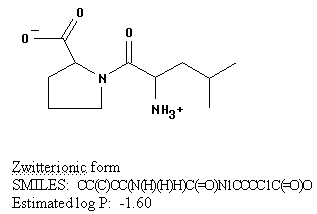
Evaluation is different for the zwitterionic and non-zwitterionic form (note the estimated log P values). It is the user’s responsibility to explicitly enter a zwitterionic SMILES into EPI Suite programs (the only exceptions are amino acids). With very few exception, the EPI Suite SMILECAS database does not use explicit zwitterionic SMILES.
Explicit zwitterionic entry is another difference between the CLOGP program (BioByte Corp; Daylight Corp) and the EPI Suiteprograms. CLOGP will always consider compounds such as 1-leucyl-L-proline (and drugs such as amoxicllin) to be zwitterionic....the EPI Suite programs give the user the option.